How to SEO for AI search?
Focus on entities, citations, and structured content tailored for generative engines.
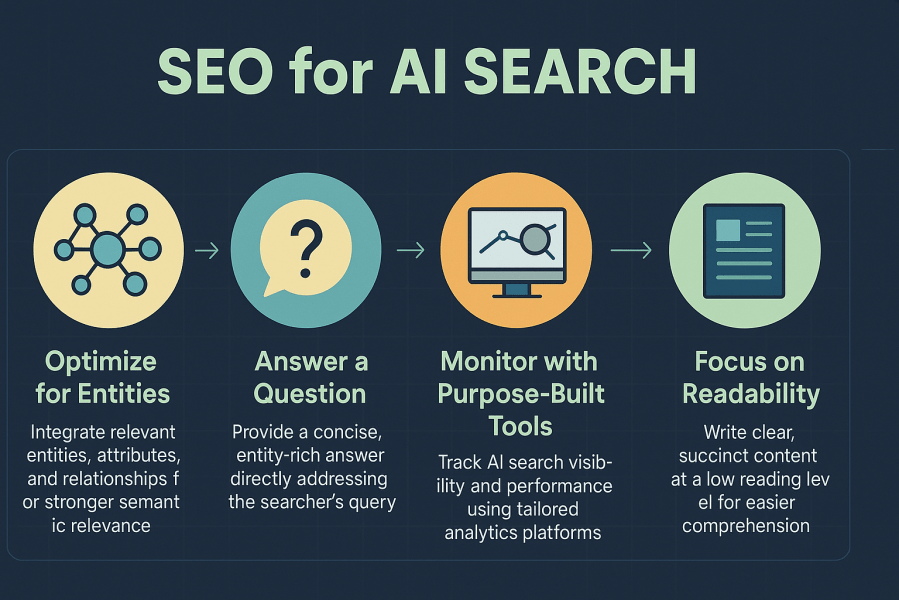
AI search—like Google AI Overviews, ChatGPT, Perplexity, and Copilot—doesn’t just crawl keywords. It retrieves, reasons, and synthesizes answers from sources it trusts. To rank, your content must tightly align with known entities, include clear semantic relationships, and appear as a reputable citation in knowledge-rich sources.
🔑 Key Optimization Tactics
- Target Entities Over Keywords
Align your content with recognized entities in sources like Wikipedia, Wikidata, and Google’s Knowledge Graph. Use tools like Perplexity, Schema.org, and Google’s NLP API to identify what entities you’re actually signaling. - Structure Like a Snippet
Use H2-format questions, 1-sentence topic answers, and concise follow-up exposition. Think: be the snippet. This aligns your content with the semantically tight Q&A style LLMs favor. - Earn Citations from Trusted Domains
AI engines prioritize sources they’ve ingested heavily—like Wikipedia, Reddit, Capterra, G2, and government or news sites. Get mentioned there. PR and digital distribution (even via press wires) can earn fast semantic lift. - Mark Up with Schema
UsesameAs,knowsAbout, and other JSON-LD tags to clarify your entity relationships. Schema won’t guarantee visibility, but it helps machines disambiguate you. - Monitor with Purpose-Built Tools
Tools like RankScale, Profound, Peec AI, Otterly, and Scrunch AI track citation visibility across AI platforms. SEMrush’s AI Toolkit is a surface-level start.
This is not just SEO—it’s semantic positioning for AI retrieval and reasoning. To win, think like a source. Write like a reference. Be the best answer.
 Will Scott