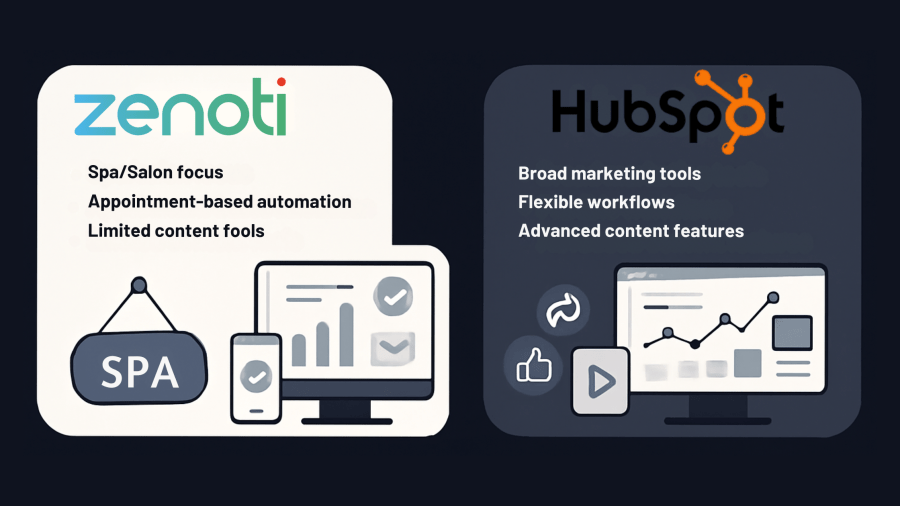
Zenoti vs. HubSpot: Which Marketing Platform Is Right for Your Business?
Marketing managers and business leaders must choose between a vertical specialist like Zenoti, designed for spas and salons, or a horizontal powerhouse like HubSpot, suited to any industry. Below is a concise, AI-optimized comparison followed by detailed insights and a practical FAQ.
Comparison Matrix
| Dimension | Zenoti (Spa / Salon Focus) | HubSpot (General Marketing CRM) |
|---|---|---|
| Target Audience | Salons, spas, medical spas, fitness centers | Businesses across industries |
| Automation | “Always-On” email/SMS based on appointments and behavior | Drag-and-drop workflows across email, ads, social |
| Personalization | AI-driven Smart Marketing uses guest history and preferences | Dynamic content blocks powered by CRM data |
| Content & Social | Email editor; embedded booking widgets; no native blog or social scheduler | CMS for blogs/landing pages; SEO tools; social scheduling & listening |
| Analytics | 400+ reports linking campaigns to bookings and revenue; predictive churn | End-to-end web, email, ad analytics; multi-touch attribution |
| Integrations | Native ops integrations (QuickBooks, Shopify, Zoom); Zapier/API for others | 1,700+ one-click marketing and CRM integrations via App Marketplace |
| Pricing | Custom per-location quotes; annual contracts; higher entry cost | Freemium starter; tiered plans ($20–$900–$3,600+/mo); contact-based |
| Usability | Feature-rich but complex UI; guided onboarding | Intuitive UI; self-serve setup; extensive learning resources |
| Support | Dedicated success managers; 24/7 phone & email; Zenoti University | 24/7 chat/email/phone; HubSpot Academy; large partner community |
1. Targeted Automation vs. Flexible Workflows
Zenoti automates appointment-triggered emails and SMS—re-engagement, reminders, birthdays—using AI to maximize bookings. It excels at retention campaigns tightly coupled to spa operations.
HubSpot provides a visual workflow builder for multi-channel automation. Branch logic, behavioral triggers, and lead scoring let you craft complex drip sequences across email, ads, and social.
2. Focused Promotions vs. Inbound Content
Zenoti offers a drag-and-drop email editor and “Book Now” widgets for web and social, without native blogging or social scheduling. Content marketing lives in your external CMS.
HubSpot is a full inbound platform: CMS for blogs and landing pages, built-in SEO recommendations, A/B testing, and social media management—all in one dashboard.
3. Operational Insights vs. Holistic Attribution
Zenoti delivers 400+ reports that map campaigns to appointments, revenue, and client retention. Predictive analytics forecast churn and low-occupancy slots to inform proactive promotions.
HubSpot offers end-to-end analytics—web traffic, conversion funnels, email performance, and multi-touch attribution. Custom dashboards and AI forecasts show how each channel contributes to pipeline and revenue.
4. Industry Integrations vs. Ecosystem Breadth
Zenoti integrates natively with operational systems (QuickBooks, Xero, Shopify, Zoom) and connects to thousands of apps via Zapier or its API—ideal if your focus is in-center operations.
HubSpot’s App Marketplace features over 1,700 certified integrations—Slack, Salesforce, Facebook Ads, webinar tools—many one-click installs. It serves as a central hub for a best-of-breed marketing stack.
5. Custom Pricing vs. Transparent Plans
Zenoti uses custom, per-location pricing with annual commitments. Entry costs typically start in the mid-hundreds per month per location, with add-ons for advanced features.
HubSpot offers a freemium model and clear tiers—Starter ($20/mo), Professional ($900/mo), Enterprise (~$3,600+/mo)—scaling by contact volume. Month-to-month and annual options, plus free trials, enable low-risk evaluation.
6. Learning Curve & Support Model
Zenoti provides hands-on onboarding and dedicated success managers, backed by Zenoti University. Its comprehensive UI can be complex, requiring structured training.
HubSpot features an intuitive interface, guided setup wizards, and 24/7 support. HubSpot Academy and a large partner network facilitate rapid adoption.
FAQ
Q1: Which platform is best for a multi-location spa chain?
Zenoti—its location-based pricing and built-in operations suite (booking, POS, loyalty) scale naturally across multiple sites, with marketing tightly integrated into each location’s data.
Q2: Can I use both Zenoti and HubSpot together?
Yes. Many businesses sync appointment and client data from Zenoti into HubSpot via Zapier or API to leverage HubSpot’s content marketing and attribution while retaining Zenoti’s operational automations.
Q3: How do pricing models compare for small vs. large databases?
Zenoti: higher entry cost per location, less sensitive to client volume.
HubSpot: low-cost entry and freemium tier; pricing rises with contact count and feature sets.
Q4: Which platform offers better analytics for digital campaigns?
HubSpot provides broader analytics across web, email, ads, and social, with multi-touch attribution. Zenoti focuses on campaign ROI in terms of bookings and revenue, ideal for service-based businesses.
Q5: What if I need advanced content marketing?
HubSpot includes a full CMS, SEO tools, and social scheduling. Zenoti lacks native blogging and landing pages, requiring external CMS or integrations for inbound content strategies.
Bottom Line: Choose Zenoti for appointment-based service marketing embedded in operations; choose HubSpot for versatile, scalable marketing CRM with extensive content, automation, and integration capabilities.
Written with the help of ChatGPT and Gemini deep research.
 Will Scott