
Imagine being THE authority on a topic and still losing the AI search. That’s exactly what’s happening to Working Genius. And the problem isn’t content quality. It’s design. A series of UX decisions are making their core message invisible to machines.
Angie (my partner in all things) introduced me to the Working Genius model to think about for our team. She shared a handful of podcasts and, of course, while listening to them I did some searching. I expected a clean, authoritative answer from the official site. Instead, I got an AI Overview – in which they were underrepresented – and their ad.
In essence they had to pay to show up for their program because the site’s own explanation was locked inside a fancy widget no AI could parse.
This isn’t about Working Genius. It’s about what their site unintentionally teaches us: AI search engines like Google’s AI Overviews can’t extract answers from content that isn’t properly structured. In the new world of Generative Engine Optimization (GEO), visibility depends on semantic clarity.
This is a textbook example of what not to do in AI SEO, where content needs to be readable not just by people, but by large language models powering generative search.
The Consequences in Search
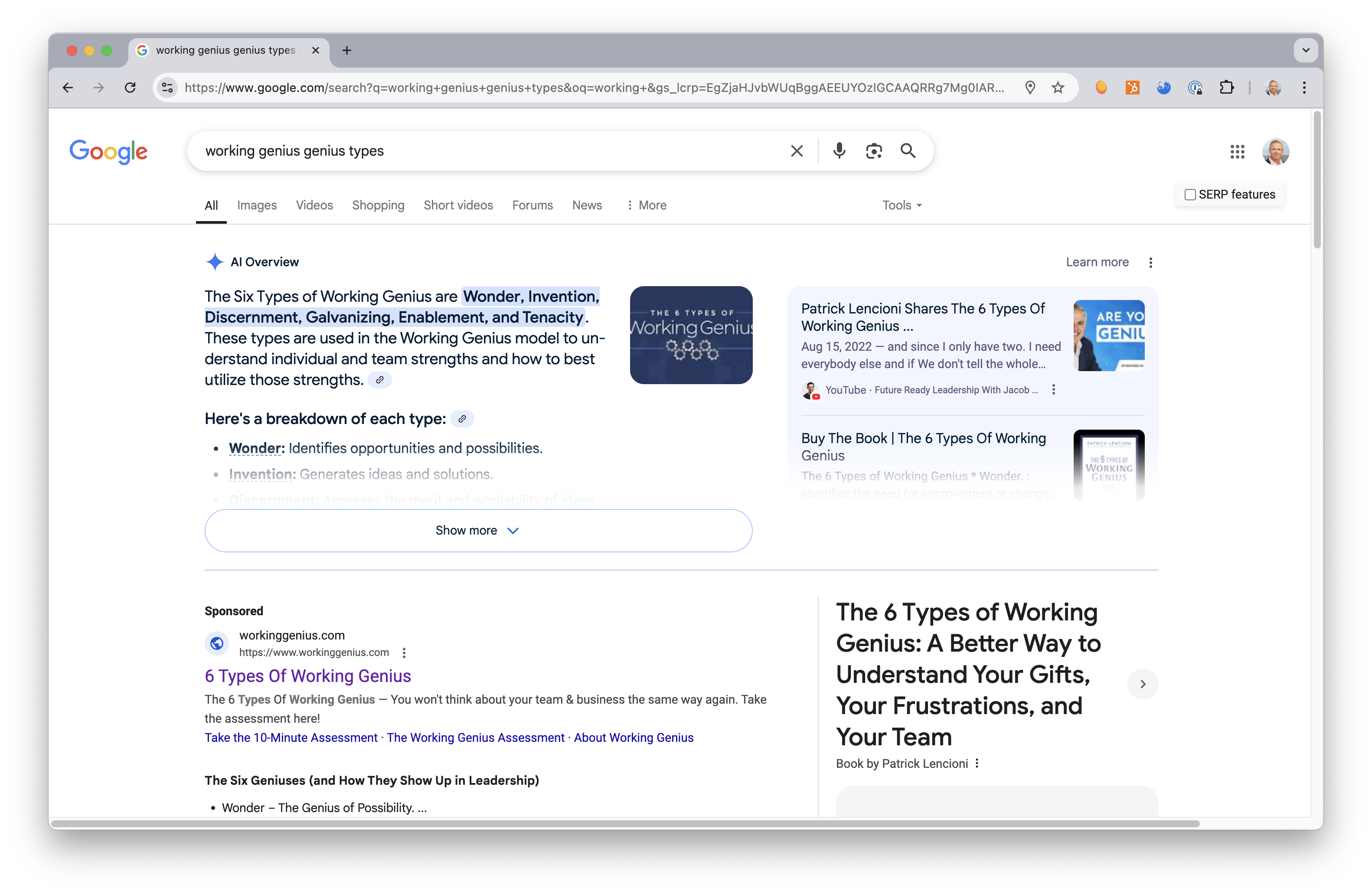
Working Genius has to buy their own brand to show up for their core concepts.

The actual text of the Working Genius WIDGET acronym is hidden behind a click-to-reveal widget.

The framework is buried in the “About” page, not on its own, and only accessible with an anchor link.
Fixing AI SEO Mistakes: A GEO Remediation Plan for Working Genius
1. Expose the Content in Plain Text
Include the full Working Genius acronym explanation as readable HTML — outside the widget. You can still keep the interactivity for style, but structured, crawlable text matters for both traditional SEO and AI Overviews.
2. Use Proper Headings and Semantic Structure
Each Genius type should be marked up with h2/h3 tags, followed by brief, clear descriptions. AI and search engines rely on this structure to extract summaries, populate featured snippets, and support generative answers.
Example Semantic Markup:
<script type="application/ld+json">
{
  "@context": "https://schema.org",
  "@type": "DefinedTermSet",
  "name": "Working Genius Framework",
  "description": "A framework that outlines six types of working genius for team and personal effectiveness.",
  "hasDefinedTerm": [
    {
      "@type": "DefinedTerm",
      "name": "Wonder",
      "description": "The ability to identify the need for improvement or change."
    },
    {
      "@type": "DefinedTerm",
      "name": "Discernment",
      "description": "The ability to evaluate and assess ideas and situations using intuition and judgment."
    },
    {
      "@type": "DefinedTerm",
      "name": "Galvanizing",
      "description": "The ability to rally people and inspire action."
    },
    {
      "@type": "DefinedTerm",
      "name": "Enablement",
      "description": "The ability to support and assist others in their work."
    },
    {
      "@type": "DefinedTerm",
      "name": "Tenacity",
      "description": "The ability to push projects through to completion and ensure results."
    },
    {
      "@type": "DefinedTerm",
      "name": "Invention",
      "description": "The ability to create original and novel ideas or solutions."
    }
  ]
}
</script>
3. Create Dedicated Entity Pages
Build focused, authoritative pages for:
- “What is Working Genius?” (Definition)
- “The Six Types of Working Genius” (Framework)
- “How to Apply Working Genius” (Implementation guide)
These strengthen internal linking, clarify topic scope, and help AI systems build stronger entity relationships.
4. Add Structured Data (FAQ Schema)
Implement relevant schema types to support structured visibility:
- FAQ schema (for commonly asked questions)
- DefinedTerm schema (for each genius type)
- Article schema (for deep explanations)
- Organization schema (for brand presence)
5. Avoid Overreliance on Javascript Rendering
Ensure key content loads in raw HTML and isn’t hidden behind client-side rendering or dynamic elements. If LLMs can’t see it, it won’t be cited.
6. Reinforce with Internal Linking
Link to the explanation page with descriptive anchor text throughout the site. This helps AI search systems contextualize and associate that page with your brand’s authority.
💡 What Is GEO (Generative Engine Optimization)?
GEO is the evolving practice of optimizing content not just for search engines, but for the LLMs and AI systems that generate answers. That means focusing on semantic clarity, structured markup, and scannable text that machines can extract and summarize.
Traditional SEO vs. GEO: What’s Changing?
| Traditional SEO | Generative Engine Optimization (GEO) |
| Keyword density | Semantic clarity |
| Backlinks | Entity relationships |
| Meta tags | Structured data |
| Page speed | Machine readability |
| Mobile-first | AI-first |
Closing Thoughts
Even great ideas can get lost in the noise – especially when web design puts style ahead of structure. In the era of AI search, clarity wins. Not just for rankings, but for real-world discoverability.
Don’t let your best content stay hidden. Build for humans and for the machines that help them find you.
Want to learn all about AI for SEO?

Join us at SMX Advanced in Boston in June, or in October at SMX Advanced in Berlin, or for the SMX Generative Engine Optimization Master Class – version 2.0.
 Will Scott